
Model release
Introducing Kombucha-1, the most accurate speaker diarization model
Kombucha-1 is the most accurate speaker diarization model we tested, streaming or offline, has no limit on the number of speakers, and is now available as an API.
Aleksandr Ogaltsov and Egor Spirin
7 min read
More and more software runs on what is said in meetings. Assistants draw on past conversations as context, always-on agents take actions in the real world based on what they heard, workflows update the CRM after every sales call, and summaries and action items reach the team before the call has ended.
All of it depends on knowing who said what. An action item given to the wrong person, a decision credited to someone who argued against it, two colleagues merged into "Speaker 2": each error travels into every agent and workflow that reads the transcript, and into every action they take. These errors are most common in the meetings with the most people in them, which are often the ones that matter most: board meetings, leadership syncs, team planning. The more people speak, the more often today's diarization models lose track of who is who, and several popular streaming models can't tell apart more than 8 speakers at all.
Today we're releasing Kombucha-1, the speaker diarization model behind all of Jamie's production traffic, as a public API. It's the most accurate diarization model we tested, streaming or offline, even though it labels speakers while the meeting is still happening. And it stays accurate as the number of people in a meeting increases.
- State of the art across all models. Kombucha-1 scores 4.1% speaker mismatch across 237 real meetings. The best offline model, ElevenLabs Scribe v3, scores 7.5%, and it only labels speakers after the meeting ends.
- A quarter of the errors of any other streaming model. The next best streaming model, ElevenLabs Scribe v3 Live, scores 16.7%.
- Built for real meetings. There's no limit on the number of speakers. With three or more people speaking, Kombucha-1 makes less than half the errors of any other model, streaming or offline.
Why meetings are hard for diarization
Diarization answers one question: who said what. In a meeting, nobody tells the model how many people are in the room, and in the real world, that number is often large.
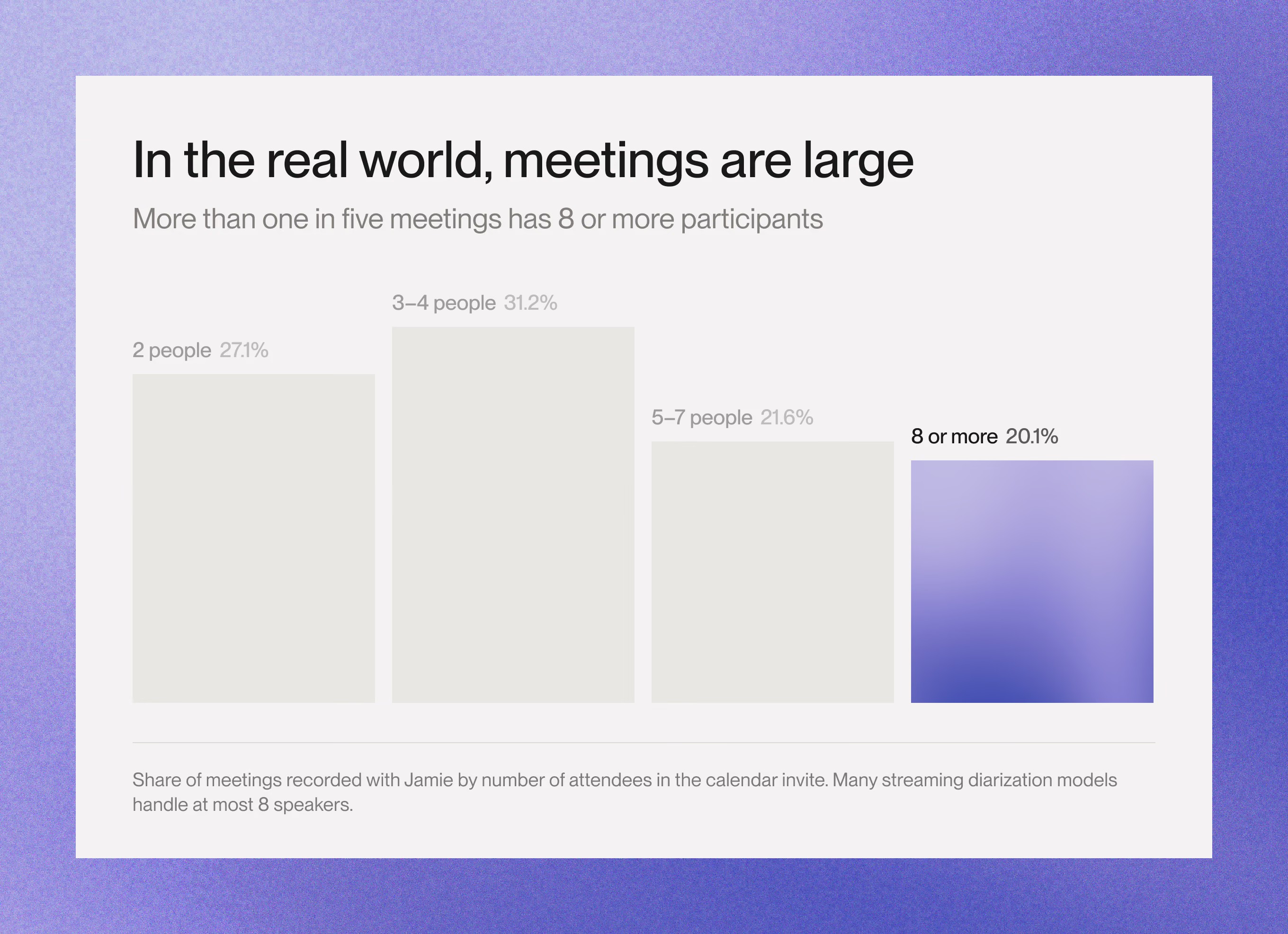
A model can get the count wrong in two ways. It can lose a speaker by folding a participant into someone else, so everything that person said appears under another name. Or it can split one person into two or more, so what they said gets distributed between strangers the model invented. The two errors pull against each other: a model that is careful about opening new speakers loses people, and one that opens them freely splits people.
A fixed speaker cap makes this worse, and many popular models have one. According to their documentation, NVIDIA's Nemotron streaming models, pyannote Live-1 and Reson8 rumble-2 handle at most 8 speakers, Soniox at most 15, and ElevenLabs Scribe v3 at most 32. A model with a limited number of speakers has to merge people in every meeting above its limit. Kombucha-1 has no limit.
Kombucha-1 doesn't support overlapping speech: it gives each moment to one speaker. That costs little in practice. In more than 1,000 hours of our own internal team meetings, only about 3% of speech overlaps, and most of it is short interjections like "yeah" or "right". We chose the 81 public meetings in our benchmark by the same criterion: less than 3% overlapping speech. Transcription models rarely drop these. They write them out in sequence, one word at a time, right before or after the words they cut across, so an interjection still lines up with Kombucha-1's labels and lands under the person who said it. So Kombucha-1 puts its capacity into getting the count and the turns right.
How Kombucha-1 measures up
Kombucha-1 is the most accurate diarization model we tested, streaming or offline. All results below use speaker mismatch: the share of each person's words that end up under the wrong name, averaged over everyone in the meeting.
We compared it with 23 configurations from 10 providers, open and closed source, on 237 meetings with 121 hours of audio and 1,408 total speakers. Besides team meetings, the benchmark includes 44 earnings calls from the public Earnings-21 set. All Kombucha-1 results come from the setup Jamie runs in production, where it works together with a streaming transcript. Kombucha-1 is trained on a few thousand of our own team meetings, none of them in the benchmark. Because it listens to voices rather than words, it works in any language, including meetings that switch languages mid-sentence.
State of the art across all models
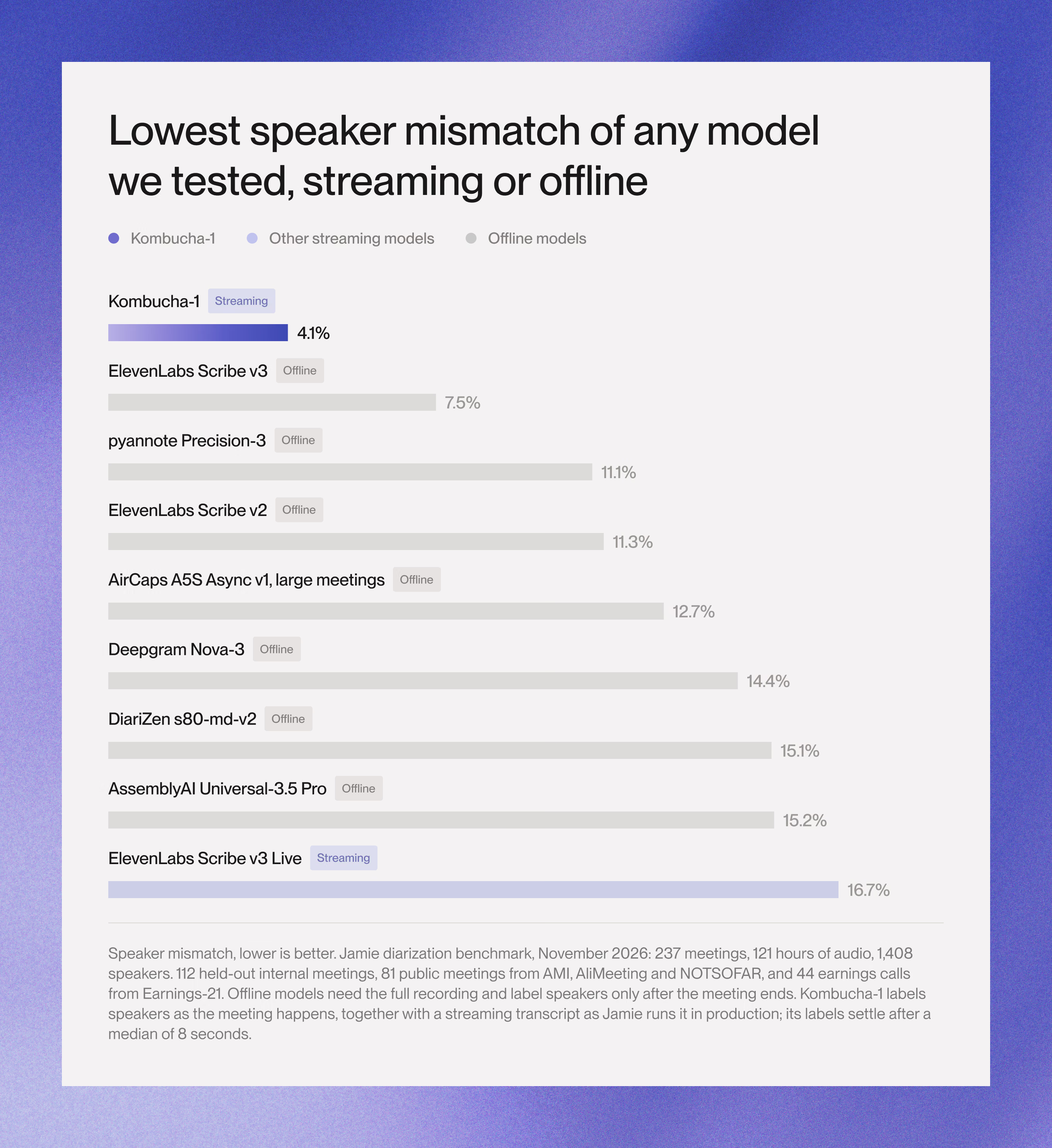
Offline models wait for the whole recording and label speakers after the meeting ends. That gives them context a streaming model never has, and it's why streaming diarization usually trails offline.
Kombucha-1 breaks that pattern. Labeling speakers as the meeting happens, it scores 4.1%, against 7.5% for ElevenLabs Scribe v3 and 11.1% for pyannote Precision-3, the two best offline models. It also leads on our internal team meetings (4.7% against 7.8%) and on earnings calls (4.9% against 6.6%), and in two-person meetings it's still the most accurate model we tested, at 3.1%.
Speaker diarization in real time
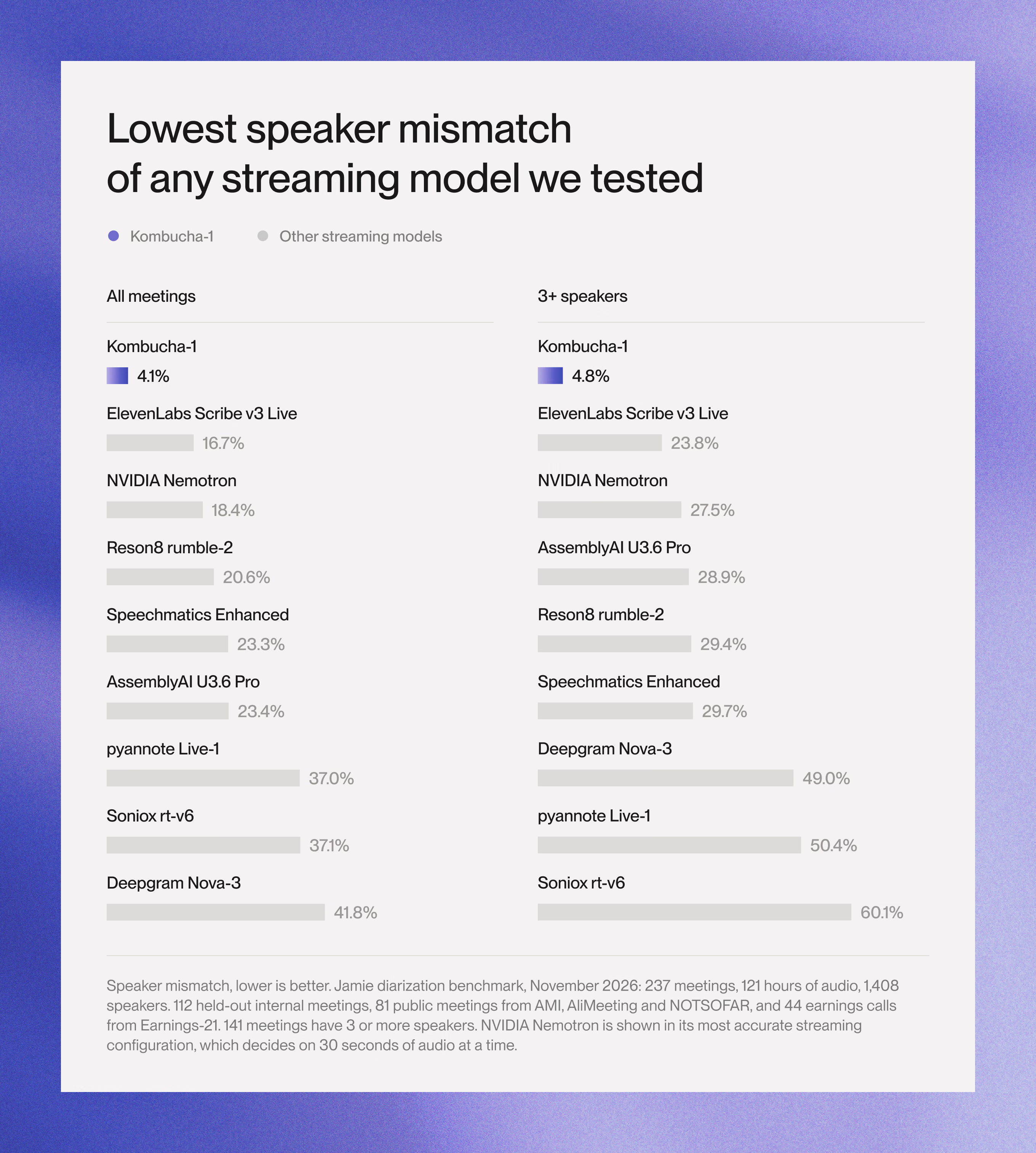
Among streaming models the gap is wider still. Kombucha-1 makes about a quarter of the errors of ElevenLabs Scribe v3 Live (16.7%) and NVIDIA Nemotron (18.4%). With three or more speakers, every other streaming model makes at least 23.8% errors, and Kombucha-1 makes 4.8%.
Beyond the benchmark, we run Kombucha-1 on our own company standup every day, with more than 30 people on the call, and its performance there is very consistent.
Finding every speaker
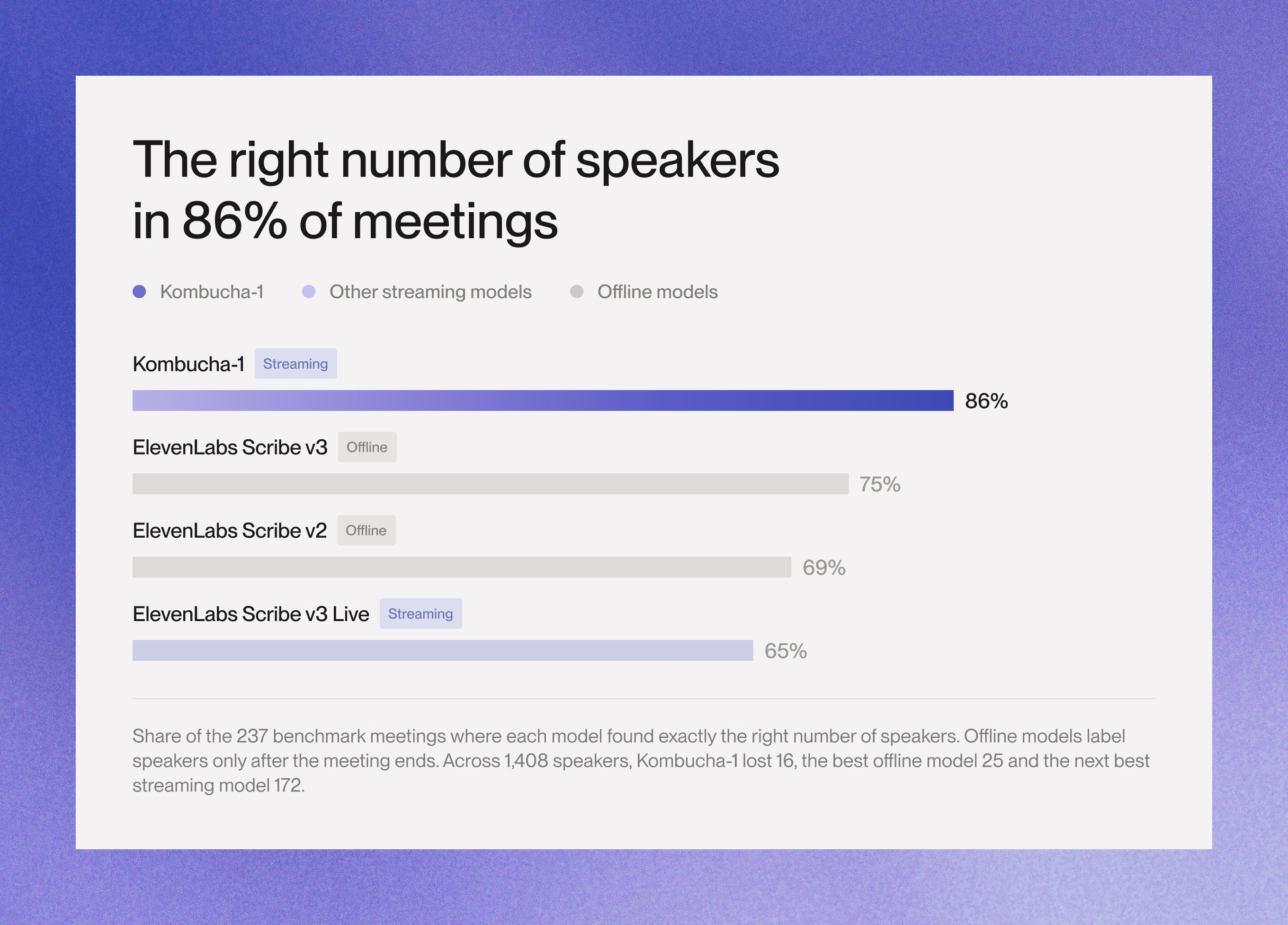
When a model loses a speaker, everything that person said appears under someone else's name. Across the 237 meetings, Scribe v3 Live lost 172 people, nearly three for every four meetings. Kombucha-1 lost 16, about one for every 15 meetings, fewer than any other model, including the best offline model, which lost 25. Kombucha-1 found exactly the right number of speakers in 86% of meetings; no other model, streaming or offline, did better than 75%.
Accuracy and latency
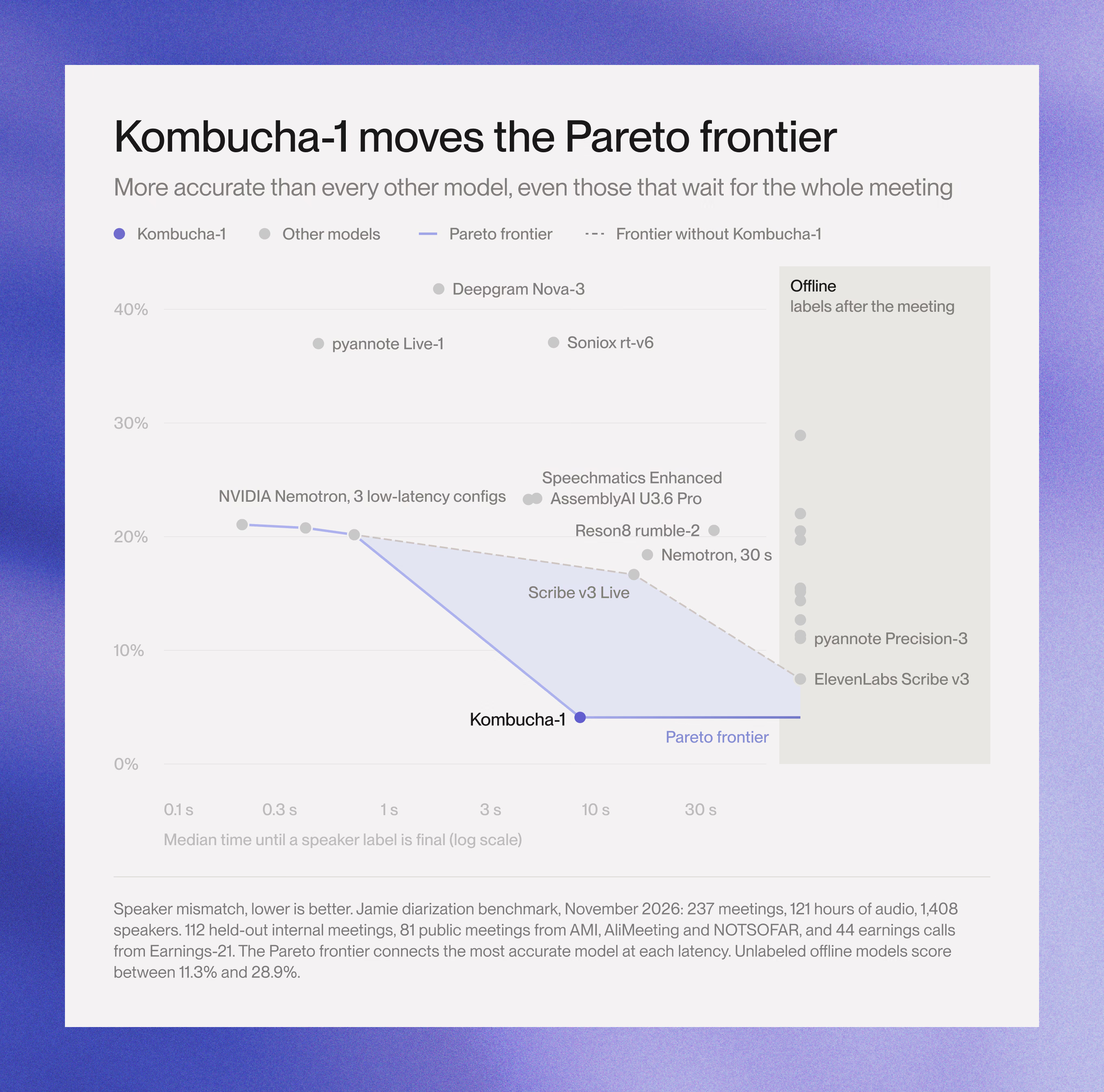
The fastest streaming models decide within a second and pay for it in accuracy, and offline models wait for the whole meeting. Kombucha-1's labels settle after a median of 8 seconds, sooner than Scribe v3 Live (14.4 seconds) and Nemotron's most accurate configuration (16.7 seconds). No model is more accurate at any delay, including the offline models that wait until the meeting is over.
How we measure speaker mismatch
The standard diarization metric, DER, counts seconds of audio. A model can score well on it while merging a quiet participant into the meeting's main speaker, because the quiet person didn't talk for long. In a meeting, that person's three sentences may be the decision.
We chose speaker mismatch because it's the measure most representative of what our customers care about: every person's words under the right name. It treats every person equally. For each real speaker, we compare the words they said with the words shown under their name. A word counts against them if they said it and it appears under someone else, or if it appears under them and someone else said it. Two kinds of mistakes count in full. If the model merges a real person into someone else, so they never get a label of their own, that person scores 100%. If the model invents a speaker who isn't in the meeting, that made-up speaker also scores 100%. We average over the speakers in each meeting, then over meetings.
What each kind of error costs
Pick a mistake to see how the model's transcript of a short meeting changes, and how speaker mismatch scores it.
Cleo is merged into Ben, so she never gets a name of her own.
What was said
AnaShall we ship on Friday?
BenFriday works, I'll prep it.
CleoSame here.
AnaGreat, thanks.
What the model shows
AnaShall we ship on Friday?
BenFriday works, I'll prep it. Same here.
AnaGreat, thanks.
Highlighted words are shown under the wrong name.
- Anaevery word matches
- Ben2 of 7 words don't match
- Cleo (lost)never gets a name of their own
Kombucha-1 gives every word to a speaker. It has no "unknown" bucket that would make its score look better than the transcripts people actually read.
Built for privacy
Meeting audio is some of the most sensitive data a company has, so we built Kombucha-1 to never need it stored. It processes audio on the fly and keeps none of it. Audio is processed in the EU, and zero data retention is the API's default, not an enterprise feature. Our Trust Center has the details.
Get started today
Kombucha-1 costs $0.04 per audio hour, and new accounts get $200 in free credits, enough for 5,000 hours. Follow the quickstart to stream your first audio.